Nikon Af-p Nikkor 70-300mm F/45-56 Vr Dox Review
In this in-depth review of the Nikon AF-P NIKKOR 70-300mm f/4.5-5.6E ED VR lens, we will take a close look at what this full-frame lens has to offer when used on modern Nikon DSLR cameras, go over its features and compare it to its predecessor. The Nikon seventy-300mm f/4.5-5.6E VR AF-P was announced in July of 2017 as a major update to the existing seventy-300mm lens design, optimized for high-resolution camera bodies, and armed with the latest optical technologies. Sporting a pulse stepping motor to evangelize ultra-fast and completely silent autofocus operation, along with an electronic diaphragm, it is quite a bit different compared to the Nikon 70-300mm f/4.v-5.6G VR it replaced. And while it might resemble its DX analogue, it arguably has fiddling in common (aside from the stepping motor), as we volition reveal farther downwards in the review.
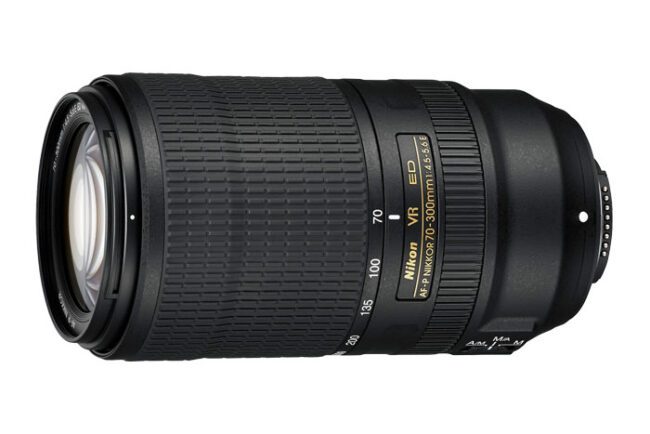
While the Nikon 70-300mm f/4.5-5.6G VR has been a popular choice amidst photographers for many years at present, information technology has been long due for an update, especially when used on modern high-resolution Nikon DSLRs. Instead of making modest updates to the lens design, Nikon decided to practice a complete redesign of the lens and release something that is sharper, faster and lighter – quite a difficult task to reach for a budget zoom lens! Featuring an 18 chemical element optical design in fourteen groups that includes 1 extra-low dispersion element, along with an electronic diaphragm, the seventy-300mm f/4.5-5.6E VR AF-P is indeed sharper (as you will come across on the comparing page), significantly faster (in autofocus operation) and 65 grams lighter when compared to the "M" version. As an added bonus, the new blueprint is also dust and moisture-resistant. And at $749 MSRP, information technology is without a dubiousness a great deal.

When compared to its DX counterpart, the Nikon 70-300mm f/4.5-half dozen.3G DX VR AF-P, it plainly covers a full-frame image circumvolve, which is the nearly of import distinction. While both lenses have a similar AF-P pulse stepping motor to drive autofocus to its limits, there are a number of differences worth pointing out. Get-go of all, the FX version has a faster maximum aperture on the long end (f/5.6 vs f/6.3), which ways that you get a bit more than light when shooting zoomed in.
Second, the FX version has an electronic diaphragm, while the seventy-300mm DX is a "G" blazon lens, which means that it even so has the older transmission aperture lever control. Third, the FX version features a rounded 9-blade diaphragm, whereas the DX version has a rounded seven-blade diaphragm. 4th, the DX version has an inferior optical design comprising of fewer glass elements (14 vs 18) and it has smaller glass elements (due to smaller image circumvolve), which means that information technology is also significantly lighter in comparison (415 grams vs 680 grams). Fifth, unlike the FX version, the DX version is not dust and moisture-resistant. 6th, the DX version is made to be a upkeep lens, which means that information technology has fully plastic construction, including the lens mount, whereas the FX version has a more than solid build and a metallic mount. And lastly, there is likewise a huge difference in price, with the FX version costing almost twice every bit much every bit the DX version.

All in all, as you tin see, the new Nikon 70-300mm f/4.5-five.6E VR AF-P is drastically different when compared to all other seventy-300mm lenses Nikon has made in the by.
Compatibility
While all this sounds dandy, there is 1 major issue that might prevent some photographers from buying this lens, and it has to do with its compatibility. Unfortunately, the new "AF-P" pulse motor design is only fully compatible with the latest Nikon DSLRs, so if you lot are planning to use this lens with an older Nikon camera, you will need to check the data below:
- Fully compatible models: D850, D500, D7500, D5600, D3400.
- Fully compatible models (without limitations) after available firmware update: D5, D4, D4S, D810, D810A, D800, D800E, Df, D750, D610, D600, D7200, D7100, D5500, D5300, D3300.
- Compatible models with limited functions: D3, D3X, D3S, D700, D300, D300S, D7000, D5200.
- Incompatible models: D2 series, D1 serial, D200, D100, D90, D80, D70 series, D60, D50, D40 series, D5100, D5000, D3200, D3100, D3000, film SLR cameras.
I used this lens almost exclusively on the Nikon D850 and I did not meet whatever issues, just when testing the lens in my lab using the Nikon D810, I did have some hiccups with focusing, especially when pre-focusing and letting the metering timer expire. Since the lens does not have a distance indicator window, there was also no style to meet where I was focusing relative to shut focus or infinity. Nikon released firmware updates in February of 2018 that made most Nikon DSLRs uniform with AF-P lenses, which is skillful news.

If you lot do own a fully uniform camera model from the in a higher place listing though, be prepared for a great experience!
Nikon 70-300mm f/iv.five-5.6E VR AF-P Specifications
- Mount Blazon: Nikon F-Bayonet
- Focal Length Range: 70-300mm
- Zoom Ratio: 4.3x
- Maximum Discontinuity: f/4.5-5.vi
- Minimum Aperture: f/32-40
- Maximum Angle of View (DX-format): 22° fifty′
- Minimum Angle of View (DX-format): v° 20′
- Maximum Angle of View (FX-format): 34° 20′
- Minimum Angle of View (FX-format): eight° 10′
- Maximum Reproduction Ratio: 0.25x
- Lens (Elements): 18
- Lens (Groups): 14
- Compatible Format(southward): Full Frame / APS-C
- VR (Vibration Reduction) Image Stabilization: Yeah
- Diaphragm Blades: 9 (Rounded)
- Electronic Diaphragm: Yes
- ED Drinking glass (Elements): 1
- Super Integrated Coating: Aye
- Autofocus: Yeah
- AF-P (Pulse Motor): Yes
- Internal Focusing: Yes
- Minimum Focus Altitude: 3.94 ft. (1.2 1000)
- Focus Mode: Machine / Manual, Manual / Motorcar, Transmission
- Filter Size: 67mm
- Accepts Filter Type: Screw-on
- Dimensions: three.2 in. (80.5 mm) x 5.vii in. (146 mm)
- Weight: 24 oz. (680 yard)

Detailed specifications for the lens, along with MTF charts and other useful data tin be institute on the Nikon AF-P NIKKOR 70-300mm f/4.5-5.6E ED VR page of our lens database.
Lens Handling and Features
When planning my trip to Jordan and Turkey, I was very conscious of the weight of the gear I wanted to bring with me. Pro-grade lenses are great, just they are big and heavy, making them painful to travel with, especially when traveling overseas. Later taking a few pictures with the seventy-300mm VR AF-P on the Nikon D850, I knew that the 70-200mm f/2.8 was going to stay behind, no matter how much I loved it. The lighter lxx-200mm f/4 lens would have been another choice, but at the expense of losing 100mm of focal length, plus larger size and heavier weight. Since I was already taking a bunch of other gear, I had very limited space in my camera purse, and so the Nikon 70-300mm VR AF-P turned out to be a no-brainer when compared to all other options. After many days of extensive travel, I was thankful for choosing this lens for my telephoto needs and its handling was a large part of information technology. At merely 680 grams and a tiptop of 146mm, the Nikon 70-300mm VR AF-P fit i of my smaller camera purse compartments easily, and when mounted on a camera, it was hands to walk around with it, without putting as well much weight on my neck or my shoulders. Because of this, fifty-fifty when I had to empty most of my camera bag during extensive hiking and daily activities, I often ended up leaving this lens in my pocketbook, which was peachy. So for me personally, its small size and lightweight construction are the two main reasons for considering it every bit a prime choice for travel photography needs.

The lens balances great on full-frame Nikon DSLRs and using it in the field is quite effortless. It has a very uncomplicated, nevertheless effective barrel design. The zoom ring is very big and is conveniently placed in the front office of the lens, so that you can easily zoom in and out when needed. My copy of the 70-300mm VR AF-P did not have zoom creep in either direction, although with extensive use of the lens, the zoom ring might loosen up overtime. The focus ring is quite modest every bit on many other like lenses, and is located closer to the lens mount. Due to the pulse focus motor, focus is driven by wire electrically, which means that you volition not see changes in focusing when rotating the focus ring if your camera has no battery. When engaged, the focus band works very smoothly, making it conduct similarly to modern AF-S lenses.
One personal gripe of mine is the lack of a altitude indicator window, which tin can be useful in the field when I want to quickly run across where the lens is currently focused at. Due to the nature of focus-by-wire motors, information technology is no longer possible to display this on lenses, unless the information is presented electronically either on the camera itself, or on a lens, something Nikon has not yet implemented. Information technology is probably non a big bargain for about people though.

The lens barrel merely has 2 switches. The get-go switch controls autofocus / manual focus behavior, while the second switch is there to control VR (Vibration Reduction). In that location are two VR modes available – "Normal", which is what you want to use most of the fourth dimension, and "Sport", for shooting fast action and panning fast-moving subjects. While the butt itself is made out of tough plastic, the lens mount is made out of metal. As I have already pointed out before, there is no aperture lever on the lens mount, because the lens sports an electronic diaphragm.
The front of the lens is fairly small and accommodates 67mm filters. This is unchanged from the older 70-300mm f/4.5-five.6G VR, then if you decide to upgrade, you can reuse your existing filters. The front of the lens chemical element does non rotate while focusing, and the lens extends out past less than 50% of its size when zoomed all the fashion to 300mm (it takes almost a quarter of a manus plough to go from 70mm to 300mm).

Existence a variable aperture lens, the focal length of the lens changes as you zoom in from f/4.5 to f/5.half dozen on the long stop. Refer to information below for maximum aperture at unlike focal lengths:
- 70mm: f/4.five
- 100mm: f/4.8
- 135mm: f/5.0
- 200mm: f/5.iii
- 300mm: f/five.6

It is of import to point out that some other key difference between the new 70-300mm VR AF-P and the older AF-S / G version, is that the new lens has a closer minimum focus distance of 1.ii meters (versus 1.v meters). This means that you can get even closer to your subjects, assuasive the out of focus areas to appear relatively larger and less pronounced than before.
Source: https://photographylife.com/reviews/nikon-70-300mm-vr-af-p
0 Response to "Nikon Af-p Nikkor 70-300mm F/45-56 Vr Dox Review"
Post a Comment